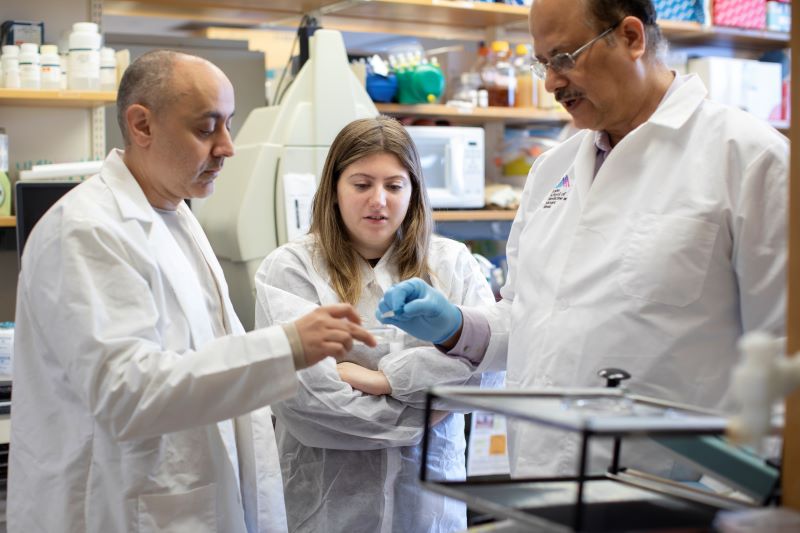
Jose Silva, PhD, left, Program Director, Master of Science in Biomedical Science, and Professor, Pathology, Molecular and Cell Based Medicine, and Oncological Sciences, shown in his lab.
The Graduate School of Biomedical Sciences, part of the Icahn School of Medicine at Mount Sinai, has announced a new curriculum structure for its Master of Science in Biomedical Science (MSBS) program.
The MSBS program, started in 2005, features the multidisciplinary research education available at the school, a commitment to translating fundamental biomedical research into disease prevention and novel therapies, and a dedication to preparing students to contribute to the biomedical enterprise in the non-profit or for-profit sectors.
The program prepares students for a range of health-related advanced degree programs and careers, whether focused on medicine, such as the MD program; research, such as the PhD and MD-PhD programs; or manager-level employment in the clinical and industrial sectors. Eligible students should have a degree in science or a related discipline from an accredited college or university.
“For 20 years, our MSBS program has successfully prepared our students for future success in advance degree programs. Nonetheless, we recognized that a changing job environment required us to provide students with more options, and the new program structure does just that,” says Eric Sobie, PhD, Senior Associate Dean for Master’s in Basic Science Programs.
The program has been restructured to address the changing educational landscape. The new MSBS program offers four distinct tracks that target different types of students and provide greater flexibility for how students can complete the program. The total minimum credits has been reduced from 45 to 36 credits over two to four semesters.
Students will choose their track based on their career goals and stage of life:
Track 1: Post-Baccalaureate Pre-doctoral (pre-PhD or pre-MD-PhD): This full-time, four-semester track requires students to complete a master’s thesis based on original laboratory research and features a staggered block schedule to facilitate focused study. Students will learn the fundamentals of biomedical sciences while engaging in hands-on research in the laboratories of their chosen Principal Investigators.
Track 2: Post-Baccalaureate Pre-medical (pre-MD): This full-time, three-semester track also follows a block schedule structure. Students graduate with a capstone project and a final comprehensive examination. This track allows students interested in applying to MD programs to better prepare for the MCAT exam by offering a lighter course load during the spring semester. Students also benefit from non-curricular experiences available at The Mount Sinai Hospital, such as clinical shadowing.
Track 3: Industry/Clinical/Professional Development: This flexible track, available in three or four semesters, combines a block schedule alongside a capstone project. It caters to individuals working in the clinical, educational, or private sector who aim to enhance their skills and advance their careers into higher-ranked, better-paid positions.
Track 4: Accelerated Industry/Clinical/Professional Development: This faster-paced version of Track 3 consists of two full-time semesters with a block schedule, a capstone project and a final comprehensive examination. It is designed for individuals seeking to enhance their skills within a condensed time frame.
“Our new curriculum retains our unique hands-on training while offering more options and flexible tracks to support your career goals. Whether you’re interested in research, healthcare, or industry, and whether you’re a recent graduate or a professional looking to advance, we’re committed to helping you gain the knowledge and experience needed to take your career to the next level,” says Jose Silva, PhD, MSBS Program Director and Professor, Pathology, Molecular and Cell Based Medicine, and Oncological Sciences.
These tracks will continue to leverage the multidisciplinary training areas available at the Icahn School of Medicine at Mount Sinai through the PhD programs in Biomedical Sciences, Neuroscience, and the recent joint PhD program in Health Sciences in Engineering with the Rensselaer Polytechnic Institute. This structure allows students to earn a specific concentration or specialization notation on their transcripts by completing a minimum of six credits in concentration-related elective courses, in addition to the required courses and a thesis or capstone project in concentration-related fields.
Students can choose from nine specialty areas to tailor their studies, including:
Cancer Biology
Disease Mechanisms and Therapeutics
Development, Regeneration, and Stem Cells
Immunology
Genetics and Genomics
Microbiology
Neuroscience
Artificial Intelligence and Emerging Technologies in Medicine
Health Sciences in Engineering
Visit our website or contact us to learn more about this program and find out which track aligns with your schedule and career goals.
“Our teams think of AI as augmented intelligence, versus artificial intelligence,” says Robbie Freeman, DNP, RN, Vice President of Digital Experience and Chief Nursing Informatics Officer at the Mount Sinai Health System. “The goal is to leverage AI as a supportive tool to enhance clinical decision-making—not to replace it.”
He adds, “Risk assessment models and tools for guiding care have always been integral to nursing practice. By combining nursing expertise and critical thinking with the ability to analyze vast amounts of data, AI is transforming how we deliver care, elevating quality and safety to unprecedented levels. In the coming years, this technology will continue to support nursing practice by enabling the creation of highly targeted, personalized care plans for every patient.”
Shown from let: Eric Kim; Prem Timsina, ScD; Arianna Goldman; Dhaval Patel; Maria ‘Vickee’ Sevillano, RN; Kim-Anh-Nhi Nguyen, MSc; Robbie Freeman, DNP, RN; and Arash Kia, MD, MsC
“Every AI project starts with a working group,” says Dr. Freeman, “and that working group always includes the people who are delivering care. For example, if we’re working on a falls-related initiative, we sit down with front-line nurses, with geriatricians, with nurse leaders, and from day one we’re talking together about what might be helpful.”
Currently, Mount Sinai nurses are using a machine learning model that predicts which patients are most likely to fall while in the hospital. The data behind this tool largely came from examining electronic medical record (EMR) data. By combing through nursing notes using recognition algorithms, Mount Sinai also developed an AI tool to better identify which patients are at higher risk for becoming delirious while in the hospital so that tailored preventive interventions could be put in place at the earliest opportunity.
From left: Prem Timsina, ScD; David Reich, MD, Chief Clinical Officer, Mount Sinai Health System, and President of The Mount Sinai Hospital; Robbie Freeman; Matt Levin, MD, and Arash Kia, MD, MsC
Mount Sinai is leading the world in developing a variety of AI products that support nurses and keep patients safe, according to Dr. Freeman.
Another AI product came about when Maria ‘Vickee’ Sevillano, BSN, RN, CWCN, COCN, a Mount Sinai clinical nurse, proposed an idea focused on the prevention of pressure injuries, also known as bed sores.
“We embraced the idea, collaboratively explored its nuances through a co-design process, and partnered with our internal data scientists and software engineers to transform it into a fully realized product,” says Dr. Freeman. “We tested and fine-tuned it, and in early 2024 the idea brought forward was introduced to the clinical setting. This predictive software is currently embedded in our EMR at The Mount Sinai Hospital, and we hope to expand its use as we continue to evaluate the product.”
Mount Sinai has also done a lot of work with a new type of AI called large language models, which, among other tasks, can recognize and generate large amounts of text. One particular study involved examining nursing triage notes to identify predictors for which Emergency Department patients were likely to be admitted to the hospital.
“In many cases the nursing documentation can really power AI,” says Dr. Freeman. “Much of nursing documentation data reflects their expert observations and has predictive power. So, using things like natural language processing algorithms, the nursing observations and assessments are really helpful in the development of AI tools that have broader use and impact. ”Mount Sinai is also using AI to help reduce the amount of time nurses spend doing documentation by rolling out macros—a sequence of computer instructions to automate a task—and tools that can streamline the process and relieve the documentation burden.
Kim-Anh-Nhi Nguyen, MSc, left, and Maria ‘Vickee’ Sevillano, BSN, RN, CWCN, COCN
As this emerging field continues to grow, Dr. Freeman says it is important to note that Mount Sinai has governance in place to ensure there is a solid understanding of how these tools work, that they are safe, and that they are being used in ways that are ethical and sound before they are being used in patient care.
“There’s a science and methodology for ensuring AI products are used responsibly,” Dr. Freeman says. The shared decision-making structure plays a critical role. Mount Sinai is also part of the nonprofit Coalition for Health AI, which brings together a diverse array of stakeholders to drive the development, evaluation, and appropriate use of AI in health care.
“AI is here and has proven it holds promise for thoughtfully revolutionizing care delivery in ways never imagined,” he says.
Levy Library staff celebrating the 50th anniversary in 2024.
The Levy Library at the Icahn School of Medicine at Mount Sinai has gone through many revamps and reiterations, but one thing remains the same—its steadfast mission of helping students, researchers, faculty, staff, and clinicians get the knowledge and information they need. November 2024 marked the 50th anniversary of the library, and for some staff, looking back at how it has grown is a source of pride.
“Over the past 12 years, I’ve had the privilege of leading the team providing library and digital services that support Mount Sinai’s entire scholarly and research community,” says Paul Lawrence, MFA, Dean for Scholarly and Research Technologies at the Icahn School of Medicine.
“I am incredibly proud to be part of a team and a 50-year legacy that exemplifies unwavering support for our mission, continually adapting and innovating while remaining committed to exceptional service,” says Mr. Lawrence, who is also Vice President for Information Technology of the Mount Sinai Health System.
The Library was named in honor of Gustave Levy and his wife, Janet Levy. Gustave Levy had been Chairman of the Boards of then-named Mount Sinai Medical Center and Mount Sinai School of Medicine, and The Mount Sinai Hospital. He helped with a $154 million fundraising effort for the medical school building and endowment, and the planning and erection of the Annenberg Building in which the Library is located.
“Witnessing the evolution and modernization of the Library’s physical spaces throughout the Health System, fostering partnerships with our research community, and advancing the Library’s commitment to supporting artificial intelligence initiatives have been true highlights for me,” says Mr. Lawrence.
Indeed, at the two-floor library, the space has constantly been updated to meet the needs of patrons. Use the sliders to look at how the Levy Library has changed over the decades.
Photo of Gustave (left) and Janet (right) Levy, taken in 1973.
Comparing Levy Library, 1980s and now
Levy Library staff have flourished alongside the library’s many changes. “I first worked at Mount Sinai in the 1990s as a lab technician; during that time, I loved to visit the Levy Library to read print journals and books,” says Jill Gregory, MFA, CMI, Associate Director for Scholarly Publishing and Visualization at the Library.
“Three decades and a medical illustration graduate degree later, I’m so excited to be a part of the Levy Library team itself,” says Ms. Gregory. “The Library is constantly evolving, from the print materials I used to reference to now being a hub of digital resources and scholarly activity. I find it so gratifying to support Mount Sinai’s clinical and scientific excellence through our team’s research and visualization skills, and I look forward to all that the future holds.”
From November 2024 through November 2025, the Levy Library is celebrating its history, its present-day achievements, and its view toward the future through a series of showcases and activities.
The Mount Sinai Health System has been an early adopter of artificial intelligence (AI) in improving patient care and health over the past few years, innovating in various clinical areas such as in imaging and patient monitoring. Now, the Health System is doubling on its investment in the field, and is opening the Hamilton and Amabel James Center for Artificial Intelligence and Human Health on November 25, a 12-story, 65,000-square-foot facility at 3 East 101st Street. The facility aims to organize Mount Sinai’s artificial intelligence (AI) efforts under one roof, to facilitate collaboration and innovation.
“Mount Sinai sees artificial intelligence and machine learning as key to our continued successes in making critical discoveries in science and in advancing medicine,” says David Reich, MD, President of The Mount Sinai Hospital.
The co-location of data scientists with the basic science and clinical scientists on the campus shared by the Icahn School of Medicine at Mount Sinai and The Mount Sinai Hospital is a strategic decision to create a community of clinical, basic, and data scientists that interact seamlessly.
Exterior of the Hamilton and Amabel James Center for Artificial Intelligence and Human Health.
Investing in AI is key to Mount Sinai’s commitment to patient health. “Science and medicine are advancing rapidly and artificial intelligence is the key to scaling our ability to help our staff be more effective in creating better outcomes and enhancing safety in multiple clinical domains and to speed scientific discovery,” says Dr. Reich.
What do the core facilities do, and what are some of the research activities going on inside? Click on each button to find out more.
Windreich Department of Artificial Intelligence and Human Health
Hasso Plattner Institute for Digital Health at Mount Sinai
Institute for Genomic Health
Mount Sinai BioMedical Engineering and Imaging Institute
The Charles Bronfman Institute for Personalized Medicine
The Department was founded more than two years ago. Its inaugural Chair, Thomas Fuchs, Dr.sc., Dean for Artificial Intelligence, set a goal of designing an “intelligent fabric”—a platform containing various AI tools and services that can be easily integrated into clinical applications at hospitals within the Health System. This centralized platform would help clinicians get a holistic view of the patient, which not only helps on the diagnostic side, but also for treatment decisions, better follow-up, and better prevention of disease, says Dr. Fuchs.
The Department has more than 80 faculty members, spanning clinicians, basic scientists, computer scientists, and engineers. In addition to creating AI tools for the Health System, it hosts the annual New Wave of AI in Healthcare conference to share findings with Mount Sinai researchers and other institutions around the country. Research areas include computational pathology and machine learning in chronic disease characterization and management. Some activities include:
Oncology: In collaboration with The Tisch Cancer Institute, an ongoing project involves the development of computational biomarkers for cancer, which could be used to predict patient outcomes and recommend treatment options or clinical trials for patients.
Neurology: The Department is involved in the 10,000 Brains Project, a philanthropic initiative that uses AI in the fight against neurodegenerative diseases such as Alzheimer’s disease and Parkinson’s disease. It intends to digitize neuropathology slides of brains across diverse populations, aiming to uncover underlying mechanisms and shed light on diagnostic and treatment options in the future.
Pathology: Team members are building what could be considered the largest academic foundation model in pathology. It comprises billions of images from millions of digitized slides to provide data and information about the microscopic world. This data could be used as a foundation for AI applications to build biomarkers, create predictive models, or answer questions about cancer and tissues.
The institute was formed in 2019 through a collaboration with the Hasso Plattner Institute for Digital Engineering in Potsdam, Germany. With a focus on software and digital health solutions, the Institute builds computational frameworks and architectures for rapid scientific discovery, and mobile applications that integrate health data from patients via wearables. With more than 12 concurrent ongoing studies, some key projects include:
AI-Ready Mount Sinai (AIR·MS): Patient data, such as scans or clinical reports, can often be siloed in separate departments. AIR·MS is a cloud-based platform that integrates Mount Sinai patient data into a consistent format. This platform allows researchers access to information about Mount Sinai’s 12 million patients to build out AI applications at scale or to conduct research.
Ehive: A platform involving a mobile application, available on the Apple App Store or Google Play, that conducts digital health studies. Participants answer questions on the app and provide other health information via wearables, such as an Apple Watch, for the study’s duration. Ehive helps researchers understand complex diseases and wellness.
Genomics involves the study of genes and genetic material and how they might affect health. Led by Eimear Kenny, PhD, Director of the Institute, teams use AI to analyze and characterize the vast information from DNA and genetic material, collected from biobanks such as the BioMe® and Mount Sinai Million Health Discovery programs, to examine the health impact of disease-associated genes and variants in real-world settings. Some key focus areas include:
Genomic discovery: Teams are involved in large-scale projects that infer population history through genetic sequencing. These studies provide information about how genetic diversity has changed throughout history, evolution, and disease. Ongoing projects vary in scope from the local population in East Harlem in Manhattan to continental populations in North and South America.
Medical genomics: With a better understanding of genetic data, researchers can infer the prevalence, clinical impact, and comorbidities associated with a particular variant. The institute is involved in the NYCKidSeq clinical trial, a collaboration between Mount Sinai, the New York Genome Center, and Montefiore Medical Center and its Albert Einstein College of Medicine, to find genetic causes of health problems in children. Other efforts look at the intersection of genomics and infectious diseases, screening, and electronic health records.
With a team of more than 45 members and under the leadership of its Director, Zahi Fayad, PhD, the Institute works at the forefront of imaging, nanomedicine, and drug delivery, with a focus on brain, heart, and cancer research. The Institute has a track record with wearable innovations, but it is also making strides in AI-powered digital solutions. Some recent innovations include:
Warrior Watch: By applying AI to analyze heart rate and other variables collected via an Apple Watch, researchers developed a way to monitor and assess psychological states remotely without requiring the completion of mental health questionnaires. The study found the AI model to be predictive in identifying resilience or well-being states.
“Digital twin”: By computationally modeling pathway interactions of cells and organs, researchers at the institute have created essentially a “digital twin” of organs. This allows researchers to make predictions about gene expression and organ function, which in turn allow for better understanding of health and disease states.
Spearheading the biobank programs, including the BioMe® and Mount Sinai Million Health Discovery programs, the Institute, guided by co-Directors Alexander Charney, MD, PhD, and Girish Nadkarni, MD, works closely with the Institute for Genomic Health and others to understand human disease through cohort studies. AI is the backbone for genetic sequencing to provide insight into how one’s genes might influence health, but also other factors including environmental and socioeconomic.
Mount Sinai Million Health Discoveries Program: This endeavor aims to carry out genetic sequencing of 1 million Mount Sinai patients in five years, and is considered one of the largest sequencing projects of its kind. With understanding of health at a local and population level, the program hopes not only to discover new therapeutics to treat and prevent disease, but also to integrate genomic profiling into routine clinical decision-making.
BioMe®: A vast, ongoing collection of de-identified data comprising information about DNA, plasma, clinical medical records, and questionnaire data, and large-scale genome-wide genotype and exome-chip data. Since its creation in 2019, the biobank has acquired information from more than 52,500 patients. The database allows genetic, epidemiologic, molecular, and genomic studies in many different fields, including inflammatory bowel disease, chronic kidney disease, cancer, allergic conditions, and more.
An essential part of achieving health equity is the fair collection of genomic data, ensuring that informed health care decisions can reflect the unique, diverse genomes of all cultures. Currently, there is a lack of diversity in genomic research data. This limits what we can uncover about health and potential treatments for our global population.
Expanding diversity among participants in genomic research can bridge these gaps, advancing our understanding of human genetics for all communities. One ambitious initiative that strives to diversify this data is the Mount Sinai Million Health Discoveries Program.
Mount Sinai Health System’s Health Equity Data Assessment (HEDA) team met with leaders of the program who expressed their challenge with identifying the ethnic identities of Mount Sinai patients participating in the program. HEDA was quickly able to assist in rectifying the data issue, which resulted in increasing the ethnic identities from 0.5 percent to 66 percent.
This assistance will have a significant impact on the program objectives. A hypothesis was formulated in the Measures and Outcomes section of the HEDA Hub. The HEDA team will track progress towards the program’s goal of reaching a million patients.
The Charles Bronfman Institute for Personalized Medicine at the Icahn School of Medicine at Mount Sinai leads this project and aims to sequence the genomes of one million Mount Sinai patients over the next five years. It seeks to integrate health and research data to drive discoveries that directly benefit a diverse patient population.
Lea K. Davis, PhD
Mount Sinai Million is poised to serve as a model for embedding genetics into routine clinical care. By leveraging data from one of the world’s most diverse patient populations within a massive New York City health system, this program seeks to deepen our understanding of the connections between genetics and disease.
In a recent conversation with Alexander Charney, MD, PhD, Director, The Charles Bronfman Institute for Personalized Medicine, and Associate Professor, Genetics and Genomic Sciences, Psychiatry, Neuroscience, Neurosurgery, and Artificial Intelligence and Human Health, Icahn Mount Sinai; and Lea K. Davis, PhD, Scientific Director of the Mount Sinai Million Health Discoveries Program, The Charles Bronfman Institute for Personalized Medicine, and Associate Professor of Medicine (Data-Driven and Digital Medicine), Icahn Mount Sinai, we gained further insight into this initiative.
Dr. Charney explains: “Our goal is to develop personalized treatments tailored not only to the disease but to the individual’s genetic makeup, which we know varies significantly across populations.”
“Equity is a core value of the scientific vision for the Mount Sinai Million,” says Dr. Davis. “We are thrilled to connect the program with HEDA and are looking forward to supporting equity-focused research through the development of this incredible resource.”
Reflecting on the broader impact, Dr. Charney says the initiative “isn’t just about collecting data; it’s about improving lives.” He envisions a health care system where genetic insights enable clinicians to make more informed, individualized decisions.
“With this kind of data,” he says, “we’re not just diagnosing based on symptoms—we’re diagnosing based on a person’s unique genetic and biological profile, which could mean a huge leap in effectiveness.”
With this forward-thinking approach, Dr. Charney and the Mount Sinai team are working toward a future where each person’s treatment is precise, effective, and, above all, personalized.
To enroll as a participant or to learn more about the Mount Sinai Million Health Discoveries Program, visit mountsinaimillion.org.
A new program at Mount Sinai Morningside represents a valuable tool to catch lung cancer—the cancer responsible for the most deaths in both men and women—at its earliest stages when it is most treatable.
Harnessing the power of leading-edge technology, the Incidental Lung Nodule Program employs artificial intelligence to sift through radiology reports ordered for patients for various conditions, looking for incidental lung nodules. These innocuous-seeming spots, often discovered during routine tests for unrelated issues, can be silent harbingers of a potentially life-threatening condition.
The program is marking its first anniversary. In just one year, it has identified more than 3,000 patients, including smokers, former smokers, and non-smokers, who may be at risk. Of these, more than 1,500 people are being actively monitored for any changes in their lung nodules, enabling early detection and intervention.
Early detection is critical, according to Javier Zulueta, MD, Chief of the Division of Pulmonary, Critical Care and Sleep Medicine at Mount Sinai Morningside.
“Our goal is to engage physicians, smokers, former smokers, and the public in early detection,” he says. “Through screening programs like ours, we can catch cancers early and significantly improve health outcomes.”
The program operates automatically, with computed tomography (CT) scans ordered for various conditions systematically scrutinized by computerized algorithms. For example, patients who may undergo scans for other cancers, heart disease, or following surgeries may be candidates for this program. Upon detection of a lung nodule, a multidisciplinary team, including specialized pulmonologists, steps in. Patients are quickly contacted, and a comprehensive follow-up plan is set in motion, ensuring monitoring, timely diagnosis, and treatment.
“The Incidental Lung Nodule Program shows our commitment to medical excellence and our dedication to serving the West Harlem community, which has elevated rates of lung cancer,” says Dr. Zulueta. “We offer not just treatment but empowerment through knowledge and early detection.”
Mount Sinai Health System has been a pioneer in the effort to diagnose lung cancers. The International Early Lung Cancer Action Project, whose goal is to ensure smokers and former smokers receive low-dose CT, was started at The Mount Sinai Hospital and has expanded around the world. Likewise, the Incidental Lung Nodule Program will be expanding across the Mount Sinai Health System.
According to the American Cancer Society, lung cancer is the second most common cancer in both men and women, not including skin cancer. Prostate cancer is more common in men and breast cancer is more common among women. Lung cancer is the leading cause of cancer deaths, according to the society. Most people diagnosed with lung cancer are 65 or older.