Updated on Jun 30, 2022 | Community, Featured

From left: Brian Meade, PE, Senior Project Manager, Planning Design and Construction; Leah Borenstein, RN, MPA, Director, Perioperative Services; and Evan L. Flatow, MD.
As the Mount Sinai Health System evolves to meet New Yorkers’ changing health care needs, Mount Sinai West is completing Phase One of a three-year plan that will vastly expand its surgical capabilities. The initiative, which began in November 2016, will enable an increase in the types and number of complex elective surgical procedures performed at the hospital, especially in the areas of Orthopedics, Neurosurgery, and Head and Neck Cancer.
The project is a key part of the transformation currently under way at the seven hospital campuses across the Health System—all efforts aimed at strengthening Mount Sinai’s ability to better serve patients.
“A large portion of Orthopedics, including hand, shoulder, and elbow surgery, along with some joint replacement and spine surgery, have already moved here from other Health System hospitals, laying the groundwork for making Mount Sinai West a center of excellence for Orthopedics,” says Evan L. Flatow, MD, President, Mount Sinai West. “Next year, we will be adding Head and Neck Cancer, as well as a movement disorders neurosurgical program, which will join the epilepsy and neuroendovascular programs here to make a Neuroscience center of excellence.”
Phase One includes a new 600-square-foot operating room and the expansion of another, the addition of three new post-anesthesia care (PACU) beds, and a completely renovated surgical reception and family waiting area, all scheduled to open in early August. The project also includes the renovation of the West 59th Street hospital entrance and lobby, and upgraded elevators to the surgical reception area.
The new reception area will streamline the surgical check-in process. It includes a bright and spacious waiting area with twice the seating capacity of the previous space, two laptop stations, two big-screen televisions, a quiet area, and two restrooms. Comfortable new seats come with individual electrical outlets for convenient phone charging. Nearby, a new consultation room enables surgeons to meet privately with a patient’s family.
“Our focus is to improve the overall patient experience,” says Leah Borenstein, RN, MPA, Director, Perioperative Services, Mount Sinai West and Mount Sinai St. Luke’s. “This really is a show stopper,” she says of the new reception and family waiting area. According to Brian Meade, PE, Senior Project Manager, Planning, Design and Construction, Mount Sinai Health System, Phase Two is scheduled for completion next March, and will include additional operating rooms, a new 3.0 T MRI, and new staff lounges.
Phase Three will add 18 private prep and recovery rooms, and is expected to be ready in October 2018. Phase Four, scheduled for completion in June 2019, will include the addition of four operating rooms and the activation of the new MRI as an intraoperative MRI, which will enable precision neurosurgical imaging in real time during surgery.
Mr. Meade says their goal is to complete the renovation for December 2019, ultimately adding six operating rooms—bringing the total to 22—and doubling the number of PACU beds to 32. Surgical support facilities for staff, upgrades to engineering systems, and an enhanced and expanded endoscopy suite are also part of the overall plan.
“Starting with convenient valet parking and the reception and family waiting area, we are designing our expansion in a patient-centered way,” says Dr. Flatow, “trying to improve the experience for patients and families going through what can be a stressful time.”
Updated on Jun 30, 2022 | Community, Featured

Emily Rubin, left, co-editor of a new anthology of work from Mount Sinai’s Writing Workshops, with Alison Snow, PhD. Click the image to watch a video about the writing program
There was a standing-room-only crowd at the recent launching of a new book, The Write Treatment Anthology, at Mount Sinai Downtown-Union Square. But it was not just any literary crowd. These were cancer patients and survivors, along with family members, friends, and Mount Sinai Health System staff. After gentle prompting, some of those who were sitting gave up their chairs for those not feeling well enough to stand for very long.
“A sold-out crowd for a literary event,” marveled Emily Rubin, who leads Mount Sinai’s two Writing Workshops, and who was a co-editor of the anthology. The book, published on Amazon.com through grants and crowdfunding, includes essays, short stories, and poems that 23 cancer patients, survivors, and caregivers have written since the workshops formed in 2011. Seventeen excerpts from the book were read at the event held on Thursday, June 15.
“We are so excited about this accomplishment—a published book, filled with the stories of our cancer patients,” said Alison Snow, PhD, LCSW-R, and Assistant Director, Cancer Supportive Services at Mount Sinai Downtown Cancer Centers.
The workshops are held on Mondays at Mount Sinai West and on Wednesdays at Mount Sinai Downtown-Chelsea Center and follow a well-worn, comforting routine: Ms. Rubin brings prompts to spur the imagination, like quotes, cards, or photographs, then participants write for about a half-hour, aiming to create a short finished product.

Connie Perry: ‘‘We writers gather close around the table, buoyed along by our continuing bravery. Not because we have each had our cancer battles, but because we bravely face blank pages again and again.’’
“It’s all inspiration for us to write together,” Ms. Rubin said at the event. “And as we write, the room fills with sighs and groans and laughter, tears, and silences heavy with thought. We think and we write, we imagine and we create, and then we read what we’ve written. The stories and poems bring beauty and light to these dark places where we end up going.”
Since the workshops began, about 300 people have taken part. One group was started by Ms. Rubin after she completed treatments for breast cancer at Mount Sinai Beth Israel, and the other was formed by Susan Ribner, an author who was treated for ovarian cancer at Mount Sinai West. The two started the groups at about the same time entirely by chance, and in an only-in-New-York coincidence, they found that they had met years before—at an aikido dojo in Chelsea. They collaborated on workshops and book readings, and after Ms. Ribner went into hospice care, she asked Ms. Rubin to take over both groups. Ms. Ribner died in 2014, and her spirit was a vibrant presence at the book launch.
One of the book’s authors, former patient Isaac Read, shared his essay “Sue Ribner” at the event: “She was a gracious, very strong woman. Weeks before she died, I called her because I had not heard from the writing class in a while. She told me that she was not teaching the class anymore, but she did not tell me how bad she was. I shared with her a quote about writing that I heard on a TV show. The quote is, ‘Writing is an act of faith, not an act of grammar.’ ”
Sales of the anthology will help fund the Writing Workshops. Copies can be purchased on Amazon.com at http://a.co/babnF9D or at emilyrubin.net.

Jack Robert Nix: ‘‘I am a soldier. I even get tattooed. it is for the bullets. electron. high beam. but I dislike the uniform. a hospital gown.’’

Jacqueline Johnson: ‘‘Whatever it was he was reaching for, he had the appearance of a warrior ready for anything, ready for the future.’’
Updated on Nov 14, 2025 | Community, Engagement, Featured

Diversity leaders Gary C. Butts, MD, and Pamela Y. Abner, MPA
DiversityInc, the nation’s leading publication in advancing excellence in diversity management, has ranked the Mount Sinai Health System No. 1 in the United States in its 2017 “Top 12 Hospitals and Health Systems” list. Mount Sinai improved its national ranking from last year when it was No. 3. In 2016, Mount Sinai also was the publication’s highest-ranked health system for diversity initiatives in the New York City metropolitan area.
Among the best practices that led to Mount Sinai’s special honor this year were its employee resource group participation, manager participation in cross-cultural mentoring, use of an executive diversity leadership board to set goals tied to executive compensation, and a commitment to expanding the supplier diversity initiative. In its top hospitals and health systems rankings, DiversityInc used a 300-question self-assessment survey of multiple diversity criteria, including talent pipeline, talent development, leadership commitment, and supplier diversity.
Situated in one of the most diverse cities in the nation, Mount Sinai is dedicated to ensuring its staff represents the population it serves. An inclusive vision and robust diversity initiatives are spearheaded by Gary C. Butts, MD, Chief Diversity and Inclusion Officer, Mount Sinai Health System, and Dean for Diversity Programs, Policy and Community Affairs, Icahn School of Medicine at Mount Sinai. The Office for Diversity and Inclusion (ODI) includes Pamela Y. Abner, MPA, Vice President and Chief Administrative Officer; Chief Program Officer Ann-Gel Palermo, Dr.PH, MPH, Associate Dean for Diversity in Biomedicine, Icahn School of Medicine at Mount Sinai; Barbara Warren, PsyD, Director for LGBT Programs; and Edward Poliandro, EdD, who supports training and education initiatives.
“The more diversity we achieve in our system of care, the better the climate for both patients and staff,” says Dr. Butts. ODI codified 14 areas to tackle in this pursuit, including focusing on patient-centric education and training of staff, engaging and advancing underrepresented groups by expanding the talent pipelines through hospital administrative residencies, and the recruiting, developing, and mentoring of faculty and staff.
“The challenge is how to translate our substantial workforce diversity into something tangible, palpable, and impactful,” Dr. Butts adds. “If we did not allow diverse teams to engage more effectively or if we did not allow for the diversity of our student body to impact learning in the medical school, then we would miss the mark.”
To create and foster an inclusive environment and support the development of a culturally competent workforce, ODI provides education and training to staff, faculty, and students on topics such as unconscious bias; racism and bias in medicine; best practices in LGBT-competent care; and enhancing the transgender patient experience and patient care. The Health System also fosters student-led advocacy groups to develop social consciousness. Members of the
ODI team regularly engage with employees—from department heads to front-line staff—to ensure they include a variety of perspectives.
“We have the focus, intention, and goodwill of people at Mount Sinai,” says Ms. Abner. This is supported by hospital presidents, deans, and other senior leadership who participate in and chair diversity councils. “Leadership has endorsed our work and that is essential.”
The ODI team continues to incorporate more inclusive initiatives into the Health System, including increased accessibility for disabled employees and a commitment to maintaining supplier diversity, particularly local businesses run by women and minorities.
“Organizations that are committed to diversity and inclusion have to work with suppliers who support those populations,” says Ms. Abner. Through the relationship, Mount Sinai will educate vendors on the particularities of working with larger corporations, providing a level of education that may further enhance the company’s future and potentially build community wealth.
“We are not perfect, but we are ahead of the field,” says Ms. Abner, who acknowledges that Mount Sinai still has areas for improvement. She would like to see more diverse representation among senior leadership and within board membership.
“We need to continue to do the good work, articulate that well, and maintain our vision,” says Dr. Butts. “There is more work to be done, without a doubt. We need to look at the gaps that need to be filled and close them. We are in a great position to do that.”
Updated on Jun 30, 2022 | Community, Featured

Lisa M. Satlin, MD, Pediatrician-in-Chief, Kravis Children’s Hospital at Mount Sinai, with Alfin G. Vicencio, MD, Chief, Pediatric Pulmonology, left, and Jeffrey M. Saland, MD, MSCR, Chief, Pediatric Nephrology and Hypertension.
Kravis Children’s Hospital at Mount Sinai has again been ranked among the nation’s top children’s hospitals by U.S. News & World Report in its “Best Children’s Hospitals” guidebook for 2017-2018.
Mount Sinai ranked in six of ten specialties and achieved top 25 rankings in two specialties—Diabetes & Endocrinology, and Gastroenterology & GI Surgery. Three departments improved their rankings over the previous year. The rankings, published annually, recognize the nation’s top 50 children’s hospitals in 10 pediatric specialty areas.
Committed to providing exceptional care to children and their families, Mount Sinai has created an alliance with the Children’s Hospital of Philadelphia (CHOP), one of the nation’s leading children’s hospitals. Patients in the New York metropolitan area now have access to CHOP specialists in fetal medicine, pediatric cardiac care, and pediatric oncology—and to the most advanced diagnostics and treatments from Mount Sinai and CHOP experts—close to home at select Mount Sinai locations.
“This year’s rankings reflect the excellent care provided to our pediatric patients and their families,” says Kenneth L. Davis, MD, President and Chief Executive Officer of the Mount Sinai Health System. “We are grateful to each one of our employees—from the physicians and nurses to the social workers and staff—for making this recognition possible through their tireless work.”
The national rankings were generated from data collected through a clinical survey sent to nearly 200 hospitals that measured areas such as patient safety, infection prevention, and nurse staffing. Part of each hospital’s score is also derived from a reputational survey that went to about 11,000 pediatric specialists who were asked to name up to 10 hospitals they consider best in their specialty for children with serious or complex medical issues.
“We continue to recruit renowned experts to our medical teams, and the excellence we have achieved at Kravis Children’s Hospital is reflected in these rankings,” says Dennis S. Charney, MD, Anne and Joel Ehrenkranz Dean, Icahn School of Medicine at Mount Sinai, and President for Academic Affairs, Mount Sinai Health System. “Innovative programs, such as our partnership with Children’s Hospital of Philadelphia, will expand access to unparalleled care for children in the New York area.”
The hospital, which sees more than 70,000 outpatient visits and 3,000 inpatient stays each year, is ranked in the following specialties:
- Diabetes & Endocrinology No. 16, up from No. 38
- Gastroenterology & GI Surgery No. 23, up from No. 27
- Neurology & Neurosurgery No. 27, up from No. 30
- Urology No. 30
- Pulmonology No. 32
- Nephrology No. 39
The Pediatrician-in-Chief of the Kravis Hospital is Lisa M. Satlin, MD, Herbert H. Lehman Professor and Chair, Jack and Lucy Clark Department of Pediatrics, Icahn School of Medicine at Mount Sinai. “Every day, our doctors, nurses, child-life specialists, and our entire staff aim to ensure that every patient receives the best possible care, leading to the best possible outcomes, in a supportive environment that is focused on each individual child and his or her family,” says Dr. Satlin.
Jul 11, 2017 | Community, Featured
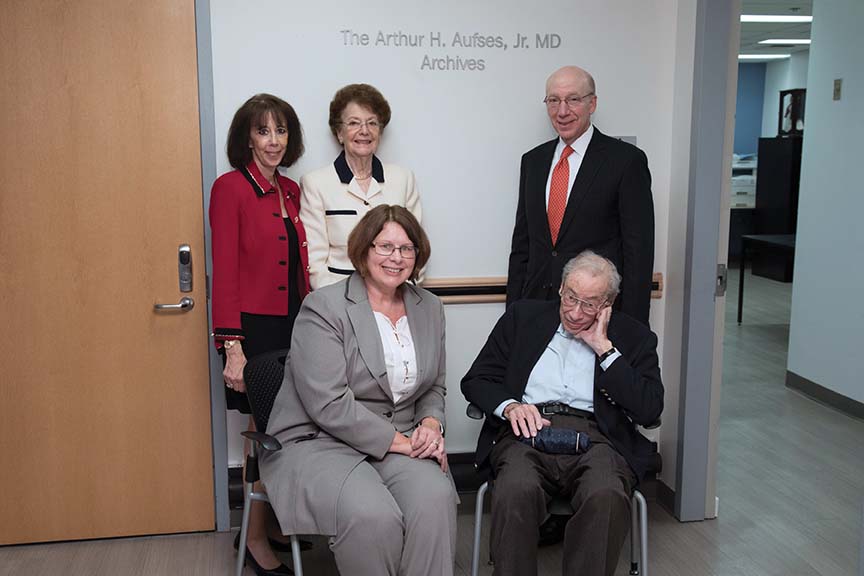
Seated: Barbara J. Niss and Arthur H. Aufses, Jr., MD. Back row, from left: Carolyn Aufses Blashek, Harriet Aufses, and Arthur H. Aufses III.
The Mount Sinai Health System’s archives, housed in a simple suite of offices on the Icahn School of Medicine at Mount Sinai campus, belies the rich trove of historical documents belonging to seven storied hospitals that are preserved inside.
Filed in these archives is an article about medicine as a noble calling that was written in 1848 by Woman’s Hospital physician E. Randolph Peaslee, MD. (The Woman’s Hospital was later merged into Mount Sinai St. Luke’s.) There are also minutes from the first board meetings for St. Luke’s Hospital from 1850, and for The Jews’ Hospital in 1852 (renamed The Mount Sinai Hospital in 1866), and the minutes from Mount Sinai Beth Israel’s founding board meeting in 1889 that were written in Yiddish.
These documents and many others from Roosevelt Hospital—renamed Mount Sinai West in 2015—and a limited collection from New York Eye and Ear Infirmary of Mount Sinai, Mount Sinai Queens, and Mount Sinai Brooklyn, provide unique glimpses into New York City’s history and how the practice of medicine has evolved over the centuries.
“History is many stories. We try to bring these stories to people at Mount Sinai so they will know and appreciate them,” says Barbara J. Niss, Director, The Arthur H. Aufses, Jr. MD Archives and Mount Sinai Records Management Program, part of the Academic Informatics and Technology Department. “The more you know about a place, the more connected you feel to it.”
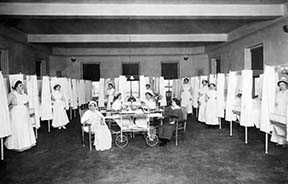
The women’s ward at Mount Sinai St. Luke’s circa 1900.
Upon request, Ms. Niss provides one-hour historical walking tours of The Mount Sinai Hospital (MSH). The Archives’ staff also creates quarterly displays in the Annenberg North Lobby on historical topics using the Archives’ records. The Mount Sinai archivist since 1986, Ms. Niss co-wrote the definitive history of MSH and its clinical and surgical accomplishments in the book
This House of Noble Deeds: The Mount Sinai Hospital, 1852-2002, with Arthur H. Aufses, Jr., MD, retired Chairman of the Department of Surgery. She and Dr. Aufses also wrote a history of Mount Sinai’s School of Medicine in 2004.
Over the years, Dr. Aufses and his wife, Harriet, have been strong supporters of Mount Sinai. They established the Aufses Family Scholarship, lectureships in the Departments of Surgery and Population Health Science and Policy, and prizes for surgical residents and students. Dr. Aufses’s Mount Sinai roots date back to 1921, when his father began his surgical training at MSH. He says he first visited the archives in the mid-1980s to look for early surgical cases. “It was an incredible experience to see the vast collection of historical material dating back to the 1850s. I became fascinated with the archives.”
Preserving, organizing, and digitizing the Health System’s archival documents is an ongoing project for the Archives staff, and content is added to the collection daily. (Mount Sinai’s Records Management Program is also based in the Archives.) The staff regularly receives requests for information about a particular medical subject, hospital within the Health System, or individual. Ms. Niss says there is ongoing interest in refugee physicians who arrived in New York after fleeing Nazi Germany, in the history of the Woman’s Hospital, and from the families of women who graduated from three of the hospitals’ former schools of nursing.
The Aufses Archives also provided significant support in establishing the Mount Sinai History Wall, an artistic timeline unveiled in December 2016 that showcases in words and pictures each hospital’s transformative contributions to medicine, science, and patient care over the past two centuries. The History Wall is located on the fourth floor of the Corporate Services Center at 150 East 42nd Street, outside the seminar room where new employees attend orientation on their first day of work at Mount Sinai.
Updated on Jun 30, 2022 | Community, Featured

Graduating residents and fellows in Ophthalmology and Otolaryngology
Faculty, parents, and friends celebrated the accomplishments of 22 residents and fellows in Ophthalmology, Otolaryngology, and Plastic and Reconstructive Surgery at the 2017 Commencement of the New York Eye and Ear Infirmary of Mount Sinai.
James C. Tsai, MD, MBA, President, New York Eye and Ear Infirmary of Mount Sinai, and Chair of Ophthalmology, Mount Sinai Health System, welcomed graduates and guests to the event, held on Thursday, June 22, at the Friends Meeting House.
“It has been a pleasure and a privilege to teach and mentor this extraordinary class. Be proud of your achievements and celebrate your successes,” Dr. Tsai said, setting out goals for the future: “Use your knowledge to lead changes in health care for the better, and deliver exceptional patient care. Challenge the status quo to make a positive difference, seek opportunities to provide global assistance to revive hope. Innovate and dream big.”
Four of the graduates were residents specializing in otolaryngology, and seven were residents in ophthalmology. The residents will now take fellowships at top-tier institutions, including the University of California, San Francisco; Wills Eye Institute in Philadelphia; and Emory University Hospital in Atlanta.
Eleven fellows completed training in subspecialties, including cornea and refractive surgery, glaucoma, ocular immunology, vitreoretinal surgery, and aesthetic plastic surgery.
